Enhancing Research Capacity in Chemical Food Safety at DTU
Enhancing Research Capacity in Chemical Food Safety
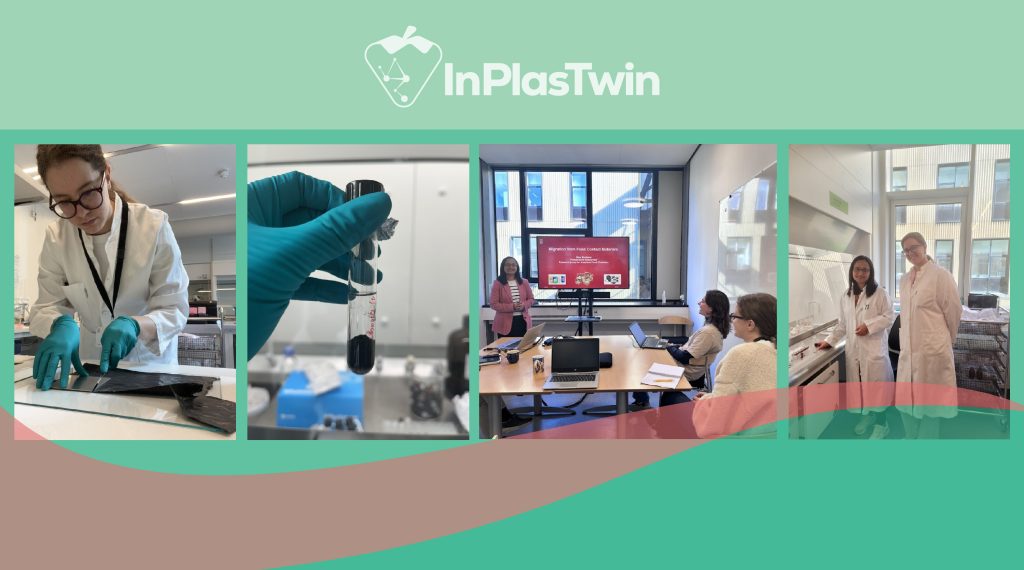
Dr. Majda Nikezić’s training focused on gaining hands-on experience and sharing knowledge on the analysis of potentially toxic organic and inorganic substances migrating from various plastic materials, particularly those used in mulching films and strawberry packaging. This collaboration took place under the expert supervision of Dr. Katrin Löschner and Dr. Bina Bhattarai within the National Food Institute’s Research Group for Analytical Food Chemistry. The insights gained are vital for the InPlasTwin project’s overarching goal of understanding the impacts of plastics in our ecosystems and ensuring food safety.
First part of Dr. Nikezić’s training involved in-depth analysis of different plastic packaging and mulching films. Her work specifically focused on understanding the migration of chemical substances from various materials, including:
-
Conventional polyethylene films (both black and transparent)
-
Biodegradable films (made from PBAT and corn starch)
The primary objective was to investigate how these substances could potentially leach into strawberries. To achieve this, her work encompassed rigorous testing methodologies, including:
-
Total Dissolution Tests: These tests provide a comprehensive assessment of all leachable components from the plastic materials.
-
Migration Tests: These experiments specifically simulate the conditions under which chemicals might transfer from the packaging or mulching films into food products, in this case, strawberries.
These experiments are crucial for understanding the implications of plastic-associated chemicals for food safety.
To achieve a deeper understanding of the chemical profiles of plastic-associated chemicals, Dr. Nikezić utilized advanced instrumentation for detecting both organic and inorganic compounds during her staff exchange. Her training included hands-on experience with:
-
LC-qTOF-MS (Liquid Chromatography coupled with quadrupole Time-of-Flight Mass Spectrometry): This powerful technique was employed for the non-targeted analysis of organic plastic additives. It allows for the identification of a broad spectrum of different compounds, providing a comprehensive “fingerprint” of organic chemicals migrating from plastics.
-
iCAP-TQ ICP-MS (Inductively Coupled Plasma Triple Quadrupole Mass Spectrometry): This instrument was used for the precise analysis of inorganic plastic additives, including various heavy metals. This method is essential for quantifying and identifying potentially harmful inorganic elements.
These advanced analytical methods are fundamental to understanding the full chemical composition of substances migrating from plastics into food simulants, thereby strengthening the InPlasTwin project’s capacity for thorough chemical food safety assessment.