What Makes Horizon Europe Twinning Projects Different? Lessons from the First 18 Months of InPlasTwin
Scientific excellence is often measured through publications, citations, and research breakthroughs. While these outputs remain fundamental to the European Research Area, achieving scientific excellence also requires strong institutions, highly skilled researchers, access to advanced research infrastructures, and effective international collaboration. Recognising this, Horizon Europe includes several instruments that not only support excellent research but also strengthen the capacity of research organisations across Europe.
Among these instruments, Twinning projects play a distinctive role. Their primary objective is to enhance research excellence by fostering strategic partnerships between institutions from Widening countries and internationally leading research organisations. Rather than focusing exclusively on scientific outputs, Twinning projects invest in the people, skills, methodologies, and collaborative networks that enable high-quality research to flourish over the long term.
The InPlasTwin project, funded under the Horizon Europe Widening programme, provides a practical example of how this approach is translated into action. During its first 18 months, the project has demonstrated that building research capacity is a continuous process involving knowledge exchange, staff mobility, methodological harmonisation, scientific networking, and dissemination alongside the generation of new scientific knowledge.
Twinning as a Capacity-Building Instrument
The scientific challenges addressed by Horizon Europe, including environmental pollution, climate change, biodiversity loss, and food security, require multidisciplinary expertise and access to highly specialised research infrastructures. However, research capacities are not evenly distributed across Europe. Twinning projects were introduced to reduce these disparities by strengthening institutional excellence through collaboration.
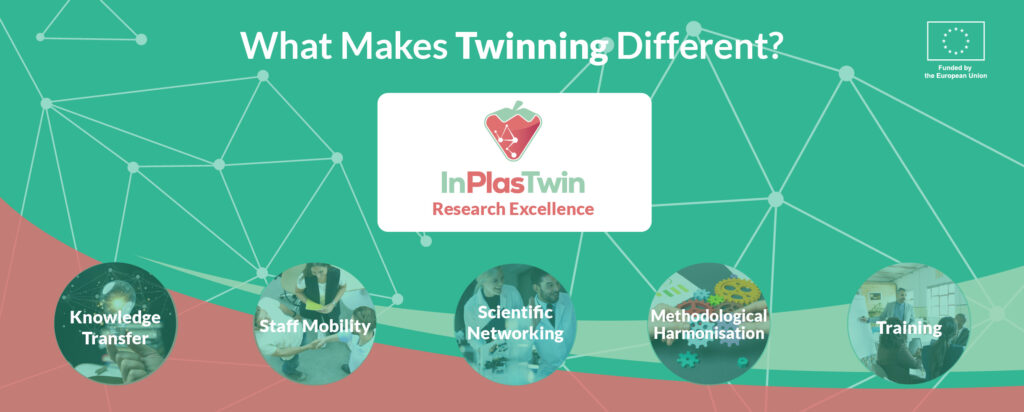
Knowledge transfer is therefore at the core of every Twinning project. This extends far beyond the exchange of scientific information through publications. It involves the transfer of practical expertise, analytical methodologies, laboratory protocols, quality assurance procedures, research management practices, and networking experience between partner institutions.
An equally important objective is to establish long-term scientific partnerships that continue beyond the duration of individual projects. By connecting researchers with complementary expertise, Twinning projects contribute to a more integrated and collaborative European Research Area.
Knowledge Transfer Through Practical Collaboration
One of the defining characteristics of Twinning projects is that knowledge transfer occurs primarily through practical interaction.
Researchers participate in staff exchanges, laboratory training, workshops, mentoring activities, and collaborative experimental work. These activities enable participants to acquire technical competencies that cannot be fully communicated through scientific literature alone. The transfer of tacit knowledge—such as instrument optimisation, troubleshooting analytical procedures, quality control, or interpretation of complex datasets—is often best achieved through direct collaboration between research teams.
In emerging scientific fields such as micro- and nanoplastics, where analytical methodologies continue to evolve rapidly, these practical interactions are particularly valuable. Establishing harmonised protocols and sharing methodological experience contributes directly to improving the reproducibility and comparability of scientific data across laboratories.
For InPlasTwin, this collaborative approach supports the development of advanced methodologies for the detection and characterisation of micro- and nanoplastics in agricultural systems while simultaneously strengthening the research capacities of the participating institutions.
Building Research Capacity Through Training and Mobility
Perhaps the most characteristic feature of Twinning projects is their emphasis on researcher development.
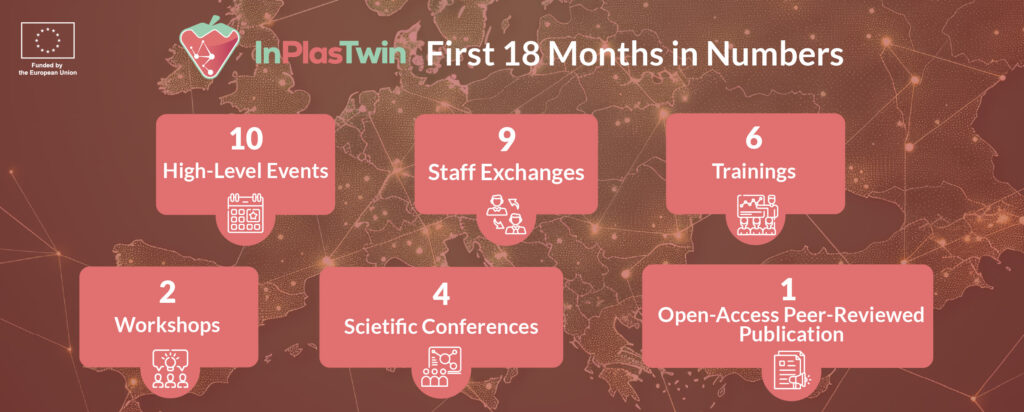
During the first 18 months, InPlasTwin has successfully implemented a comprehensive programme of capacity-building activities, including:
- 9 short-term staff exchange visits
- 6 training activities
- 2 international workshops,
- 1 scientific webinar,
- 1 brainstorming lecture, and
- 3 joint consortium meetings.
These activities represent much more than scheduled project events. Staff exchanges have enabled researchers to work directly with advanced analytical equipment, learn specialised laboratory procedures, compare methodological approaches, and gain practical experience that can subsequently be implemented within their own institutions.
Similarly, workshops and training sessions have created opportunities to discuss current methodological challenges, share emerging analytical approaches, and strengthen collaboration between research groups with complementary expertise.
By investing in researcher mobility and practical training, Twinning projects create a multiplier effect: newly acquired knowledge is transferred back to the home institutions, strengthening local research capacity and benefiting future generations of researchers.
Strengthening Scientific Networks
Another important outcome of Twinning projects is the development of sustainable scientific networks. Scientific collaboration increasingly depends on international partnerships that facilitate the exchange of expertise, access to specialised infrastructures, and joint participation in future research initiatives. Building these networks requires continuous interaction between institutions rather than occasional meetings.
During the first half of the project, InPlasTwin has strengthened its scientific ecosystem through collaborative dissemination activities, joint meetings, workshops, and networking events. The publication of a joint press release has further increased the visibility of the consortium and promoted cooperation with related European initiatives.
Although networking activities are sometimes considered secondary to research itself, they often determine the long-term sustainability of scientific collaborations. Many international partnerships established through Twinning projects continue through new Horizon Europe proposals, COST Actions, bilateral collaborations, joint supervision of doctoral students, and shared research infrastructures.
Looking Ahead
The first 18 months of InPlasTwin illustrate the broader purpose of the Horizon Europe Twinning instrument. Scientific excellence is not achieved solely by producing high-quality publications; it also depends on the strength of the research environment in which those publications are produced.
Through structured knowledge transfer, researcher mobility, specialised training, methodological harmonisation, and international networking, Twinning projects strengthen the institutional capacities required for long-term scientific excellence.
The progress achieved by InPlasTwin demonstrates that these objectives are already being translated into measurable outcomes. With ten high-level dissemination events, nine completed staff exchanges, six training activities, two workshops, an expanding portfolio of scientific publications, and an increasingly connected research network, the project has established a strong foundation for the remaining implementation period.
As experimental work progresses, these capacity-building activities will continue to support the development of robust analytical methodologies for micro- and nanoplastics while reinforcing collaboration among European research institutions. In this way, InPlasTwin contributes not only to advancing knowledge on plastic pollution in agricultural systems but also to strengthening the research excellence and collaborative culture that underpin the European Research Area.